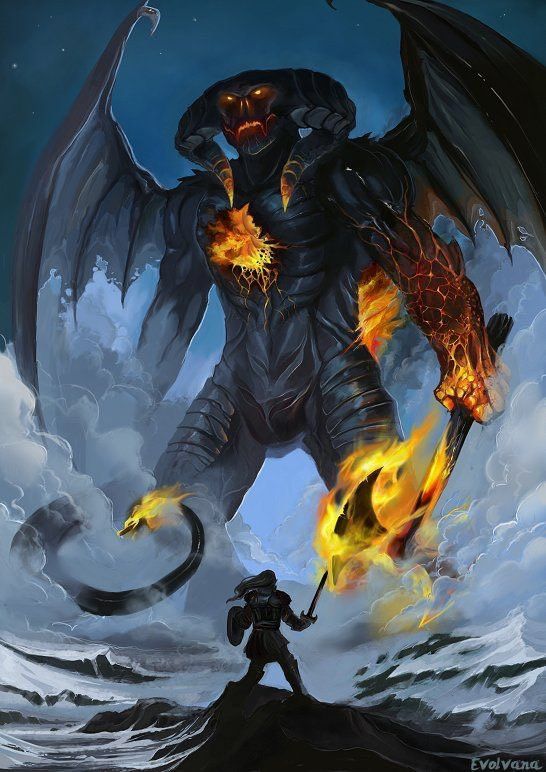
Do Balrogs have wings?
None of the images within this discussion are mine; all credit goes to the authors and artists. They can be reverse-searched for details. Also, while we are at it, protect true artists’ work and refrain from AI image usage.
Many who know me are well aware that I staunchly defend the notion that Balrogs do not possess wings, a position I am fully prepared to uphold despite acknowledging its evident inaccuracy. I have spent the majority of my time debating this with my friend Shannon. However, the true value of this debate lies not in proving a definitive answer but in the broader discussion it sparks. Conversations about Balrogs inevitably lead to deeper explorations of Tolkien’s lore, from the mystery of the Ent-Wives to the fate of the Palantiri and the merits of modern adaptations of his work. Is this argument pursued for its own sake? Absolutely. Is it an engaging and thought-provoking exercise? Without question.
But! I am comfortable re-evaluating my stance in light of evidence-based research and wholeheartedly succumbing to defeat.
I will create a small glossary below to make this a bit more comprehensive for anyone new to LOTR lore.
- Angband
- A subterranean fortress and armory inhabited by Morgoth, the Dark Enemy, and his army of fallen Maiar spirits. In many respects, Angband is comparable to the subterranean fortress and armory of Tartarus or Hell in John Milton’s Paradise Lost (first edition, 1667), inhabited by the biblical Satan, the Prince of Darkness, and his army of fallen angels. A significant difference, however, is that the pits of Angband are created by Morgoth and his allies because of their love of evil and hellish darkness. In contrast, Tartarus is designed as a place of punishment for Satan and other fallen angels. Both Angband and Tartarus serve as mighty fortresses and armories out of which lords of darkness launch their wars against the forces of light.
- Arda
- The High Elven (Quenya) name of Tolkien’s fictional world, encompassing the mortal land of Middle-earth and the immortal Undying Lands of Aman. Arda, Tolkien insisted, is not another planet but our world: the planet Earth, the one in which we now live. The author himself explained: “The theatre of my tale is this earth, the one in which we now live, but the historical period is imaginary.” The connection is made clear in the name: Arda is connected to the Old High German Erda and Gothic aipa, both of which translate as earth.
- Eru/Iluvatar
- The creator-god of Tolkien’s world of Arda, known to the Elves as Iluvatar (All father). He was certainly in part inspired by the Judeo-Christian creator-god. In the beginning, Tolkien tells us his cosmogony (creation myth). Eru’s thoughts took the form of entities known as the Ainur or “Holy Ones,” vastly powerful spirits comparable to the Judeo-Christian angels and archangels. He then commands the Ainur to sing in a celestial choir, thereby revealing his vision of “what was, is, and is to come:” Eru creates and wakens first the Elves and then Men.
- Maiar
- The lesser angelic powers who descended from the Timeless Halls into Tolkien’s world of Arda as servants of the more powerful Valar. The Maiar sometimes have counterparts among the gods, spirits, heroes, and nymphs of Greek and Norse mythology. Known Maiar: Gandalf, Sauron, Radagast, and the Two Blue Wizards sent to the East.
- Melkor
- The most powerful, inventive, and magnificent of the angelic powers known as the Ainur, but who, out of his desire to create on his own account and in his own way, is corrupted and becomes Morgoth, the first Dark Lord of Middle-earth.
- Valar
- The fourteen ruling Powers of Arda are angelic beings who, after the creation of Arda, enter into its circles and shape various aspects of it. Many of the Valar are associated with a particular realm, such as the sea, the starry night sky, rocks, and mountains. (Valar were the chosen Ainur to rule over Arda) They do not have offspring, and a majority of them are married to each other. Though many are seen as gods by Elves and Men, they are not worshipped.
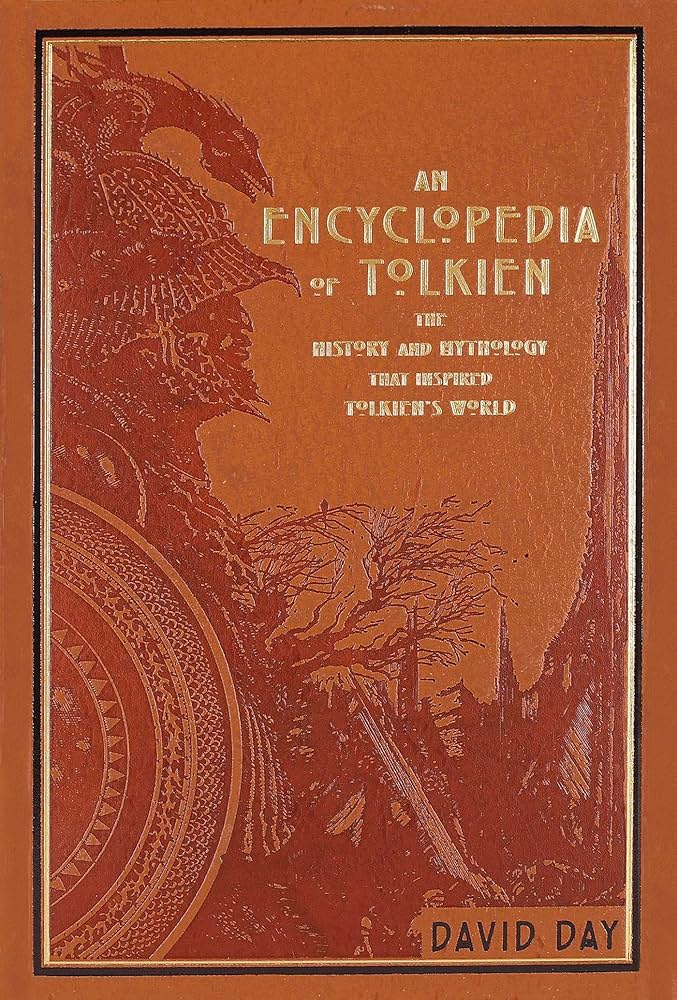
Day, David. An Encyclopedia of Tolkien: The History and Mythology That Inspired Tolkien’s World. Canterbury Classics, 2019.
Let’s start from the top. What are Balrogs? Where do they come from? Why is there confusion within the LOTR community?
Balrogs are defined in David Day’s “An Encyclopedia of Tolkien: The History and Mythology That Inspired Tolkien’s World” in two ways: The Balrog of Moria and the Balrog of Angband. See if you can find the source of the confusion about whether Balrogs have wings.
- Balrog of Moria
- A nameless terror known only as “Durin’s Bane.” For over a thousand years of the Third Age, the Balrog’s mace kept the Dwarves from their ancient kingdom of Khazad-dum, known as Moria at the time. It is not until Gandalf’s encounter with the creature during the Quest of the Ring that its identity is revealed as one of the Balrogs, the monstrous Maiar fire spirits inspired by the fire giants of Muspelheim in Norse mythology. This particular Balrog is a survivor of the War of Wrath in the First Age, having hidden itself for millennia deep beneath the Misty Mountains. It is only by chance, or perhaps fate, that the deep-delving Dwarves of Khazad-dum awaken it.
- Balrogs of Angband
- Known as the Valaraukar or “Cruel Demons” in Quenya, these mighty MAiar fire sports are among the most terrifying of Morgoth’s servants in the War of the Jewels. They take the form of man-shaped giants, shrouded in darkness, with manes of fire, eyes that flow like burning coals, and nostrils that breathe flame. Balrog’s many-thonged whips of fire in battle, in combination with amace, axe, or flaming sword. Visually, the Balrogs, while male, are comparable to the demonic Einyes (Furies) of Greek mythology, who emerged from the pits of the Underworld to pursue those guilty of crime. Furies were variously described as having snakes for hair, coal-black bodies, bats’ wings, and blood-red eyes.
Day, David. An Encyclopedia of Tolkien: The History and Mythology That Inspired Tolkien’s World. Canterbury Classics, 2019.
Balrogs originated as Maiar. They were powerful, immortal beings who existed before the shaping of Arda. However, Melkor corrupted them and made them his most feared servants.
Did the previously listed definitions mention wings? Yes, in the context of the Balrogs of Angband. However, was this description actually referring to Balrogs themselves? No, it was instead describing the Furies, the mythological figures that Balrogs were partially inspired by. This raises the question: Where does the confusion regarding Balrogs having wings originate?
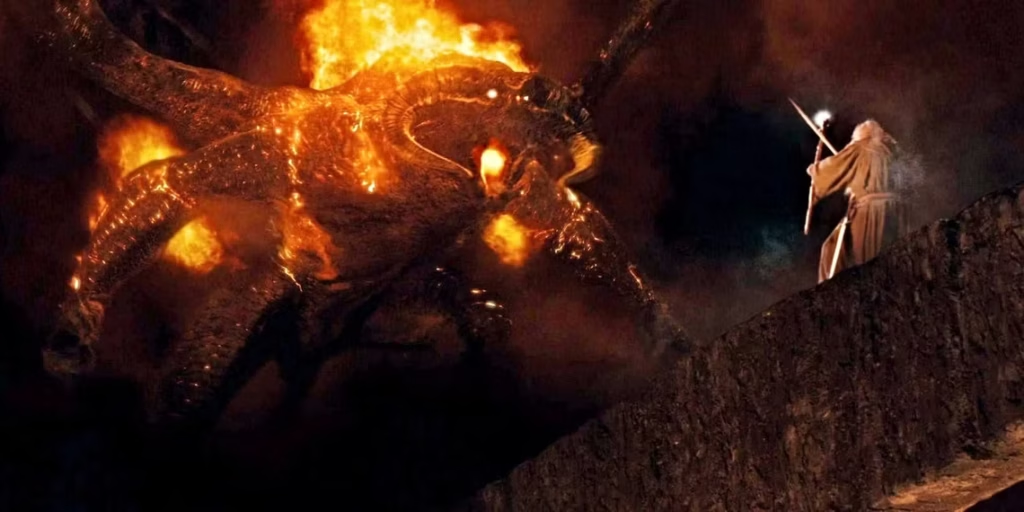
Technically a Maiar vs Maiar battle.
Many younger audiences were first introduced to Tolkien’s work through Peter Jackson’s The Lord of the Rings trilogy, released in 2001. In this adaptation of The Fellowship of the Ring, the Fellowship encounters a Balrog within the Mines of Moria. The creature is depicted as wreathed in flames, possessing a humanoid form, horns, skull-like facial features, and, yes, wings.
As a result of this portrayal, many fans accepted Peter Jackson’s interpretation as definitive and continued to regard it as an accurate depiction of Balrogs. However, more dedicated Tolkien enthusiasts recognize the meticulous effort Jackson and his creative team invested in adapting The Lord of the Rings, with the notable exception of the Balrog of Moria. For many, the more pressing omissions from the films were the absence of Tom Bombadil, the sinister Old Man Willow, and the Barrow-wights. While these were significant exclusions, they did not constitute a fundamental misrepresentation of an entire being as the Balrog’s depiction arguably did.
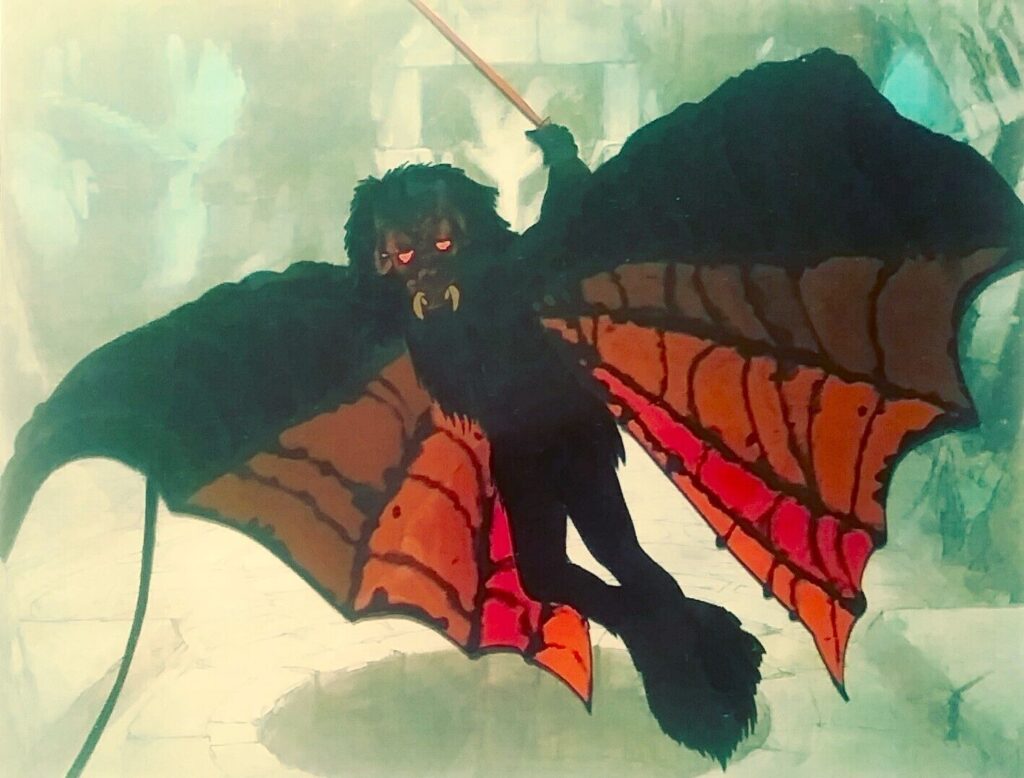
Even in the later adaptations of the film, Lord the Rings by Ralph Bakshi released in 1978, depicted Balrogs as having wings.
As we are unable to find evidence of the lack of wings in popular media adaptations, we must return to the source material.
In The Silmarillion by THE J.R.R. Tolkien he described them as creatures of shadow and fire, wielding whips of flame. In the chapter “Of the Ruin of Beleriand and the Fall of Fingolfin” he states, “Swiftly they arose, and passing over Hithlum they came to Lammoth as a tempest of fire.” Now, this can surely be interpreted as the Balrogs sprouting wings and flying over Hithlum. Merriam-Webster defines passing over as in crossing, to make one’s way through, across, or over. Ex. Passing over a bridge.
Some may point to the word “arose”, mentioned in the previously referenced text, but in The Nature of Middle-earth by J.R.R. Tolkien on page 362 in the cliffnotes it states, “1980 when a Balrog arose in Moria and it was abandoned by the Dwarves and became filled with the servants of Sauron.” So arose can be seen as awakened or quite literally, stood up.
Let’s look further into Tolkien’s texts.
“His enemy halted again, facing him, and the shadow about it reached out like two vast wings…suddenly it drew itself up to a great height, and its wings were spread from wall to wall.” Tolkien, J.R.R. Fellowship of the Ring.
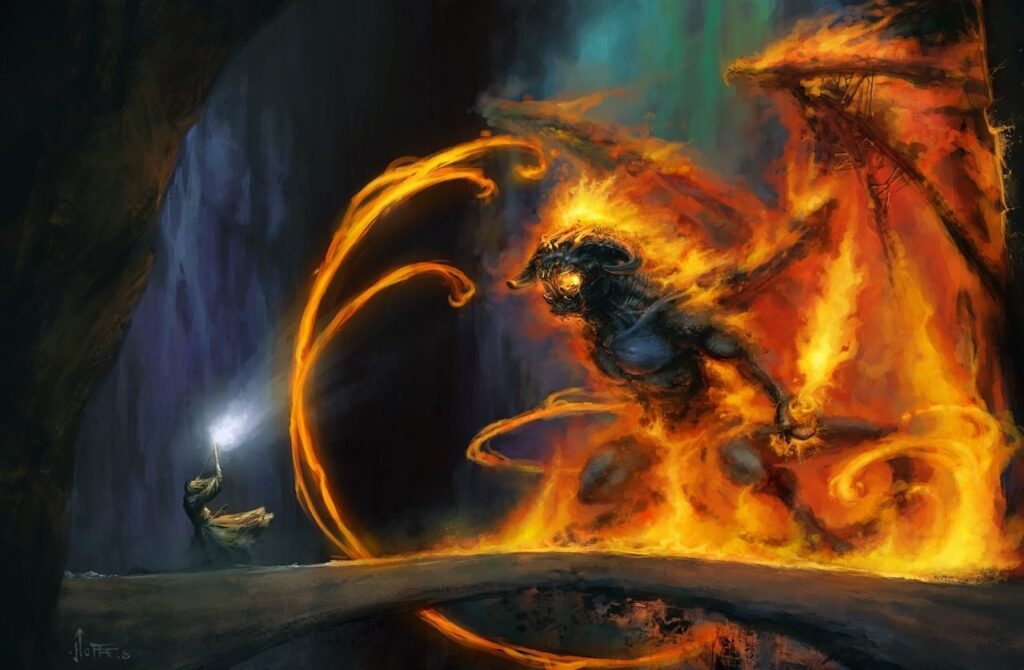
Consider this scenario: If I were to craft a highly realistic cake in the shape of a football and then proceed to throw it, would it be classified as a football or a cake? Did I throw a real football?
If shadows form around in a way that resembles wings, does that mean I possess actual, physical, bat-like or dragon-like wings?
The most definite answer is that I threw a cake.
And no, I wouldn’t have wings.
So what “spread from wall to wall”? The shadow.
Balrogs do not have physical wings; Rather, they are enveloped in shadow, likely accompanied by an overwhelming amount of smoke. In retrospect, the ventilation within the Mines of Moria was probably inadequate. Remarkably, smoke inhalation did not pose a more significant challenge to the Fellowship.
Shout out to my friend Shannon for inspiring this post. They don’t have wings.
Fin
More nerdy posts are coming soon. In the meantime, check out my post about my man Watson! If you are looking for more good Tolkien content, I recommend checking out the Tolkien Society.
Do Balrogs Have Wings? Do Balrogs Have Wings? Do Balrogs Have Wings? Do Balrogs Have Wings? Do Balrogs Have Wings? Do Balrogs Have Wings? Do Balrogs Have Wings? Do Balrogs Have Wings? Do Balrogs Have Wings? Do Balrogs Have Wings? Do Balrogs Have Wings? Do Balrogs Have Wings? Do Balrogs Have Wings? Do Balrogs Have Wings?